
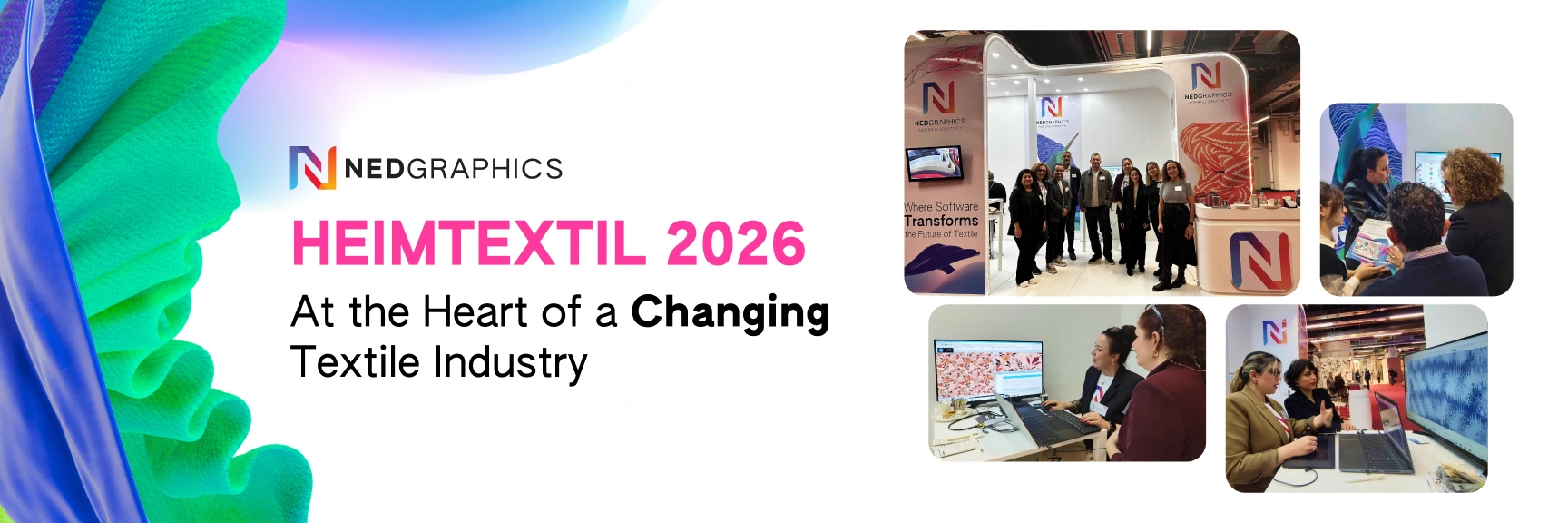
A NedGraphics-Led Restrospective
Walking into Heimtextil 2026, one thing became immediately clear. This was not just another edition of a long-running global trade fair. It was focused, intentional, and deeply reflective of where the textile industry stands today. The textile industry is no longer circling around future change. It is actively operating within it.
From the moment the fair opened, the scale and global reach of the event reaffirmed Heimtextil’s role as the industry’s central meeting point. Thousands of exhibitors and visitors arrived not to browse passively, but to engage with purpose. The conversations taking place across the halls reflected an industry that knows where its pressure points are and is actively seeking answers.
One of the clearest signals came from the way the Trend Area functioned this year, long considered the conceptual heart of Heimtextil. More than an inspiration space, it became a strategic reference point, grounding design, material innovation, and sustainability in real-world business context.
Despite the strong emphasis on technology and innovation, Heimtextil 2026 reinforced an essential truth that we strongly agree with and align to: this industry is built on people.
Longstanding clients and partners returned to see us not simply as customers, but as collaborators with shared history. These relationships, developed over decades, were visible in the ease of conversation and the depth of trust. This continuity explains why many companies continue to invest in attending Heimtextil year after year. This event is not just a marketplace. It is a community.
The multilingual, international nature of conversations at the stands further underscored this point. Textile design and production remain inherently global, and meaningful progress depends on dialogue across borders, cultures, and disciplines.
For our community, the takeaway is clear. Innovation does not happen in isolation. If you are serious about shaping the future of textile design and production, you need to be present where ideas, experience, and perspective converge. Engage in the conversations, build relationships beyond transactions, and invest in spaces that allow you to learn not just from technology, but from one another. That is where lasting progress is made.
Furthering these conversations was the topic of sustainability. It was not just positioned as a trend at Heimtextil 2026. It was presented as an operational imperative.
The concept of “Econogy,” the integration of economic performance and ecological responsibility, captured the prevailing mindset across the fair. Sustainability is no longer framed as a trade-off between creativity and responsibility. It is increasingly understood as a driver of long-term competitiveness.
This perspective was reflected in discussions around materials, processes, and digital tools. Visitors consistently emphasized the need for solutions that reduce waste, optimize resources, and support more responsible production models without compromising quality or design integrity. For us, this signals a shift in how sustainability should be approached moving forward. It is no longer enough to treat it as a parallel initiative or a downstream consideration. Sustainability must be embedded into decision-making at every level, from design and development to production planning and execution. The organizations that lead in the years ahead will be those that translate intention into measurable action and treat sustainability as a core business strategy, not a supporting message.
Interest in artificial intelligence, automation, and digital workflows was both widespread and pragmatic. The questions being asked were not abstract. They were grounded in daily operational challenges. Leaders across the industry are looking for technology that accelerates processes, reduces costs, and improves consistency. AI is increasingly seen as a means to enhance decision-making and efficiency, not to replace creativity.
At the same time, there was a clear acknowledgment that innovation must remain human-centered. While technology will continue to shape the future of textile design and production, inspiration remains rooted in human creativity and the natural world. The most compelling solutions are those that respect and amplify that balance. Technological choices should be guided by purpose, not novelty. The focus should be on tools that remove barriers, support better decisions, and create space for creative and strategic thinking. As digital capabilities expand, leadership responsibility lies in ensuring that technology serves the work, not the other way around. The most compelling solutions will be those that respect this balance and use innovation to strengthen, rather than overshadow, the human role in the creative process.


For us at NedGraphics and Optitex, Heimtextil 2026 reinforced the responsibility that comes with long-standing leadership in textile design and production technology.
Our community arrived with clear expectations. They came seeking insight, direction, and solutions that reflect the realities of an increasingly complex industry. The demand for end-to-end workflows, deeper integration between design and production, and access to connected tools from a single source was a consistent theme.
This is not simply a product conversation. It is a strategic one. And as the industry evolves, leadership is defined by the ability to anticipate needs, connect disciplines, and support customers through meaningful, scalable innovation.
In an era dominated by digital communication, Heimtextil continues to play a critical role. It provides the space for face-to-face exchange where ideas are tested, challenged, and refined, and we are grateful to have had this opportunity to connect with you.
Heimtextil 2026 demonstrated that the fair remains where trends meet application, where strategy is shaped through dialogue, and where the future direction of the textile industry is collectively negotiated.
It remains, at its core, the heart of the home textile world.
Your NedGraphics Team