
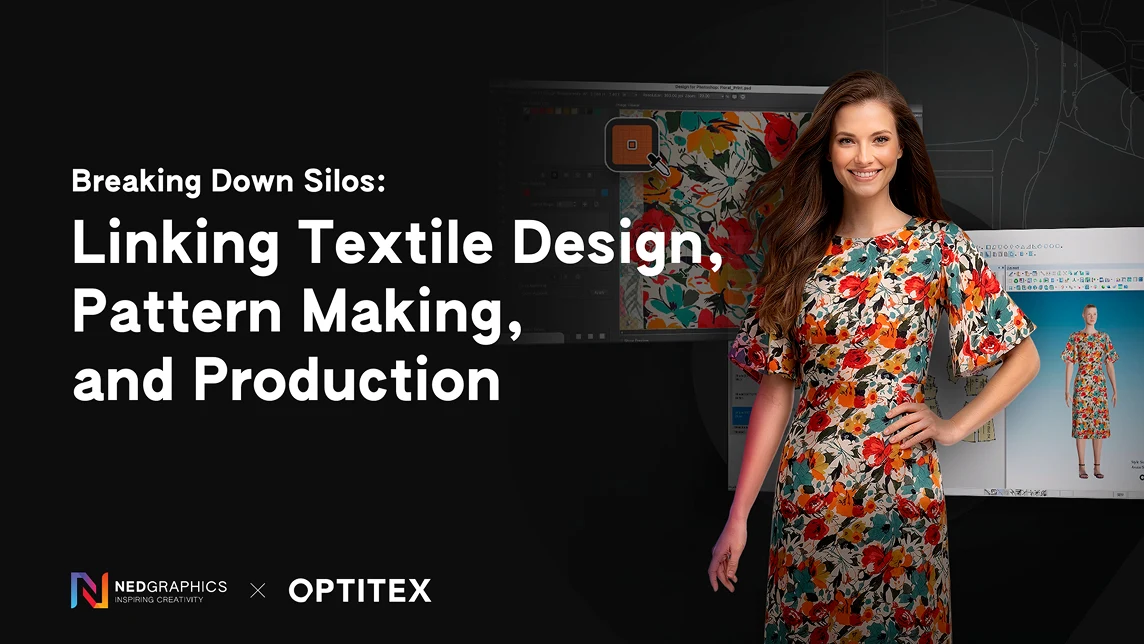
In today’s rapidly evolving world of textile and sewn goods manufacturing, one of the most persistent challenges remains bridging the gap between creative vision and manufacturing execution. A recently published case study from Texintel offers valuable insights into overcoming this disconnect, showing how interconnected digital workflows can transform the journey from textile design through to production.
At the center of this story is the partnership between NedGraphics and Optitex, two technology leaders working together to unite textile surface design, sewn product development, and manufacturing preparation. Their collaborative approach reflects an important shift happening across our industry: moving away from disconnected software tools toward unified, digitally integrated environments that help teams work better together.
One of the key challenges explored in the case study is the inefficiency created when workflows operate in isolation. Traditionally, textile designers develop their surface patterns and colorways in specialized design software, while pattern makers and technical teams must reinterpret that creative work using completely different platforms. This separation often results in lost information, miscommunication between departments, and time-consuming revisions. It slows down product development while also contributing to fabric waste and making sustainability goals harder to achieve.
The solution presented is a fully connected workflow that brings together advanced textile surface design tools with pattern creation, three-dimensional visualization, and manufacturing preparation. When teams can work within a shared digital environment, companies find it much easier to maintain design integrity throughout the entire product journey, reducing mistakes and bringing products to market faster.
What makes this case study especially relevant is how well it applies across different industries. Whether you’re working in apparel, automotive upholstery and interiors, or furniture and home textile production, the core challenge is remarkably similar: translating creative vision into production-ready specifications without losing what made the design special in the first place. The integrated NedGraphics and Optitex solutions addresses these varied needs beautifully, from optimizing fabric usage in clothing construction to ensuring precision in complex automotive seat designs and managing large-scale pattern layouts for furniture upholstery.
Another highlight worth noting is the power of digital prototyping. With sophisticated three-dimensional visualization capabilities, development teams can validate their textile designs and garment constructions before producing physical samples. This not only saves time and money but also supports environmental goals by reducing material consumption and waste.
Beyond the operational benefits, the case study emphasizes something equally important: collaboration as a strategic advantage. When textile designers and technical developers share access to design data and work within synchronized workflows, teams can align more effectively. The result is products that beautifully balance aesthetic vision with technical performance.
The outcomes speak for themselves: improved manufacturing efficiency, better product quality, less material waste, and faster time to market. But perhaps the most valuable takeaway is this broader insight: the future of design-through-manufacturing success lies in connectivity. Companies that embrace integrated digital ecosystems will be better equipped to respond to changing market needs, drive innovation, and meet increasingly important sustainability targets.
In the end, the Texintel case study reinforces an elegant idea: when textile design and manufacturing work as one continuous, connected process rather than separate activities, the entire value chain becomes stronger, smarter, and more resilient.
We invite you to explore the complete case study, including detailed workflow examples and measurable results, on Texintel: CASE STUDY: Connecting Design and Manufacturing Across Industries using NedGraphics X Optitex

Stay inspired,
Your NedGraphics Team